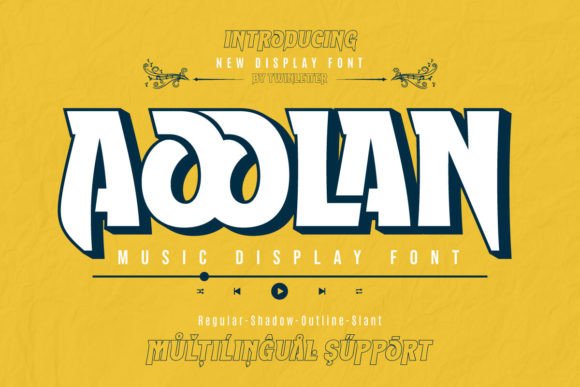
Aoolan: The Display Font with a Music Designer's Soul
Every designer knows the feeling. You're working on a project—a band's album cover, a festival poster, a boutique coffee brand—and you need a typeface that doesn't just sit on the page. You need one that hums with energy, that carries a rhythm, that feels like it was born in a recording studio or an artist's loft. This is where Aoolan enters the conversation. It’s not merely a collection of letters; it’s a sophisticated music display font built for those who see typography as an instrument in their creative orchestra.
Understanding the Six Styles of Aoolan
What sets Aoolan apart is its thoughtful family of six distinct styles. This isn't about offering a dozen nearly identical weights; it's about providing a versatile toolkit where each style serves a specific visual purpose.
- Regular: The foundation. Clean, clear, and confident, it provides the essential readability needed for longer text blocks or when you need the font's personality without extra flair. It’s your workhorse for body text on a website or detailed product descriptions.
- Outline: This style introduces artistry and lightness. It’s perfect for creating layered effects, adding a touch of elegance to logos, or giving a modern, airy feel to social media graphics where you don’t want heavy blocks of color.
- Shadow: Here is where tension and depth come in. The Shadow style adds a dramatic, almost 3D quality. Use it for headlines that need to pop off the screen, for poster titles that demand attention, or for creating a sense of vintage or industrial grit in your branding.
- Slant: This isn't a simple italic. Aoolan’s Slant carries a dynamic, forward-moving energy. It’s ideal for conveying motion, music, or a casual, handwritten feel in invitations, album art, or merchandise tags.
The remaining two styles often build on these foundations, perhaps offering a bolder weight or a combined effect, giving you even more creative range from a single typeface family.
Practical Applications for Real-World Projects
Knowing a font looks good is one thing. Knowing exactly where to use it is where the real value lies. Aoolan’s character makes it exceptionally well-suited for projects where visual storytelling is key.
For Branding and Logo Design
A strong brand identity needs a typeface that reflects its core values. If your brand is creative, artistic, or connected to music, culture, or modern craftsmanship, Aoolan can become a cornerstone of your visual language. The Regular style works beautifully for the main wordmark, ensuring clarity, while the Outline or Shadow can be used for secondary logos, monograms, or favicon variations. This consistency across assets builds instant recognition.
For Packaging and Editorial Design
Imagine a craft beer label, a vinyl record sleeve, or a boutique skincare line. Aoolan’s styles allow you to create hierarchy and focus. Use the Slant for a dynamic brand name, the Regular for descriptive copy, and the Outline for decorative elements or slogans. In editorial layouts, such as magazine spreads or blog headers, it can make feature titles and pull quotes visually arresting without sacrificing the readability of the main article text when paired with a simpler serif or sans-serif font.
For Digital Spaces and Marketing
On social media, standing out in a fast-scrolling feed is everything. Aoolan’s Shadow style can make a sale announcement or a new product launch impossible to ignore. For websites, it’s a fantastic choice for hero section headlines, section headers, and call-to-action buttons, where you want to inject personality. When creating digital products like e-books, worksheets, or online course materials, using Aoolan for titles and key points elevates the perceived value and professionalism of your content.
Making Aoolan Work for You: A Designer's Advice
Adopting a new creative font is exciting, but a strategic approach will yield the best results. Here’s how to integrate Aoolan effectively into your workflow.
Choose the Style to Match the Mood: Don’t just pick your favorite. Ask what the project needs. Is it serious and modern? Regular might be best. Is it playful and energetic? Try Slant. Need to convey luxury or edge? Experiment with Shadow or Outline. Let the project's goal dictate your style choice.
Master the Font Pairing: A display font like Aoolan rarely works alone. Its strength is in headlines and accents. Pair it with a neutral, highly readable font for body text. A clean sans-serif like Montserrat or a classic serif like Lora can provide a perfect counterbalance, letting Aoolan’s personality shine without overwhelming the viewer. Always test pairings on a sample layout before finalizing.
Respect Readability: While Aoolan is designed with precision, some styles like Outline or Shadow can reduce readability at very small sizes or in long paragraphs. Use them strategically for short bursts of text—headlines, logos, banners—where impact is more important than extended reading comfort. The Regular style is your go-to for any text that needs to be read easily.
Leverage the Full Family: The true power of a premium font family like Aoolan is in using multiple styles together. Create a visual system: use Shadow for the main title, Regular for the subtitle, and Slant for a supporting quote. This creates depth, hierarchy, and a cohesive, professional look that feels intentionally designed.
Consider Commercial Licensing: If you’re using Aoolan for client work, merchandise for sale, or any commercial project, ensure you have the correct license. Most font foundries offer different tiers (desktop, web, app, etc.). Understanding this upfront protects you legally and is a mark of professional practice.
Why This Font Resonates with Creatives
Ultimately, Aoolan succeeds because it bridges the gap between function and feeling. It provides the clarity of a well-crafted display font while infusing projects with the nuanced emotion of music and art. For the small business owner designing their own packaging, the content creator crafting a unique brand on Instagram, or the freelance designer building a client's brand identity, it offers a tool that is both distinctive and versatile. It’s a typeface that doesn’t just display words—it helps tell a story, set a tone, and connect with an audience on a more visual and emotional level. In a world saturated with generic fonts, finding one with this much character can be the catalyst that transforms a good design into a memorable one.